Starting out
Ready for your first private prescription
A guided way to dispense that a new private pharmacy can follow from day one, without an existing process to build on.
Dataforge PMR has the only dispensing queue built for private practice. Every private prescription is dispensed, labelled and sent to the patient from one place.
The same queue serves a pharmacy on its first day of private services and a dispensary with a full team.
Starting out
A guided way to dispense that a new private pharmacy can follow from day one, without an existing process to build on.
Scaling up
Each item is dispensed quickly, and manual prescription entry can be automated as your numbers rise, with robust pharmacist checks kept in place.
Your team
Dispensers work the queue under their own login, with access set by role and every action recorded against their name.
Built for the way private prescriptions arrive, not adapted from an NHS system. The Dispensing Queue collects them from every route they reach your pharmacy and shows where each one came from.
Orders from your website approved by a prescriber in the Online Forms module.
Prescriptions written after an appointment or video consultation in the Bookings module.
Prescriptions issued by your own prescribers using the Prescribing Module.
Paper prescriptions and those from outside clinics entered by your team, with a copy attached.
Less typing and fewer chances for error. The queue, labels and checks work together, so information entered once is used at every later step.
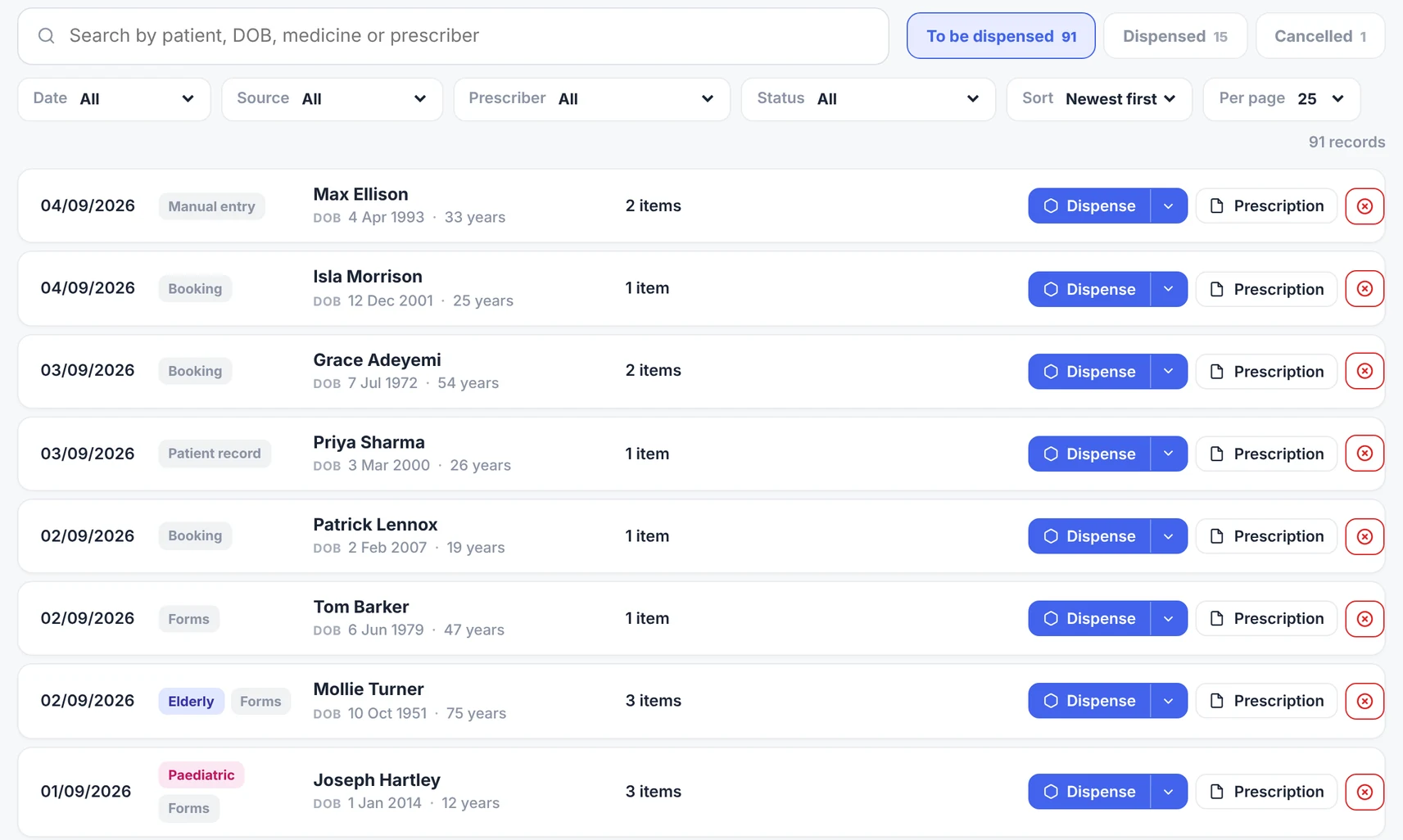
Dispensing queue
Nothing overlooked on a busy day. Each prescription is ready to dispense from the same screen, and dispensed and cancelled prescriptions are kept for reference.
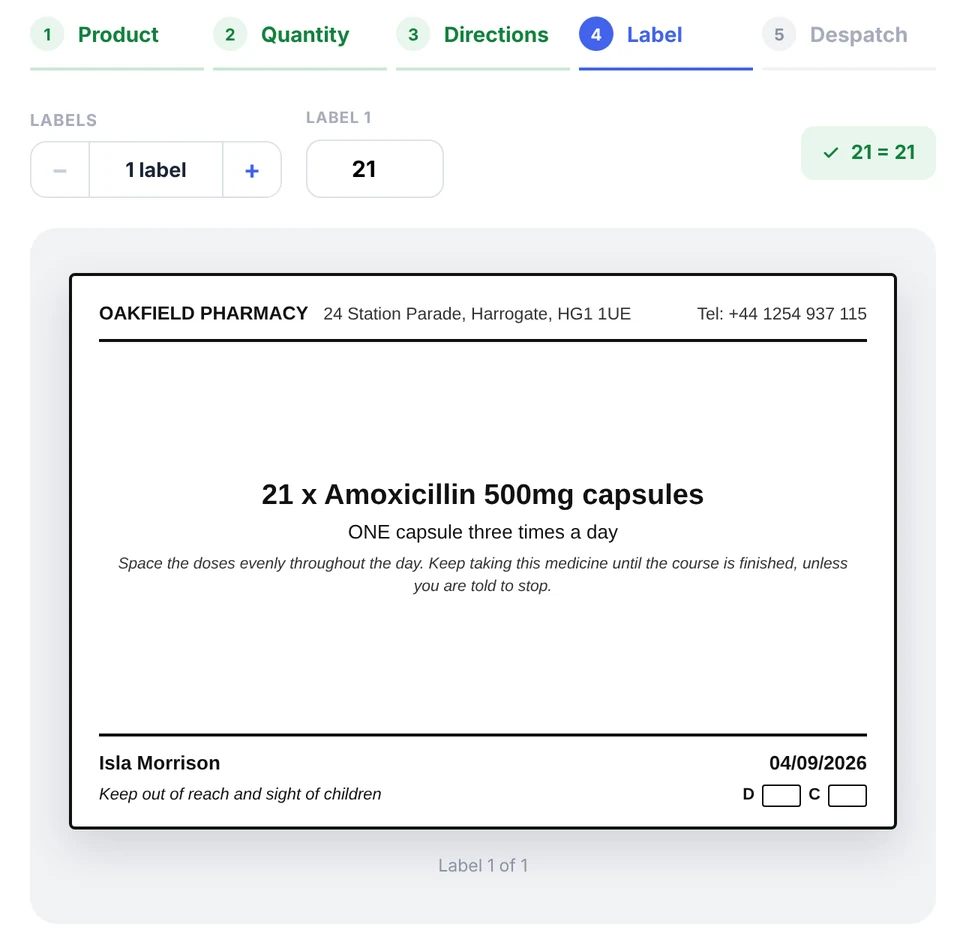
Dispensing labels
Labels that match the prescription every time. Each label is produced from the prescription and previewed before it is printed.
Your formulary
No limit on what your private service can supply. Any medicine can be added to your drug database, whatever your specialism.
Accuracy checks
Mistakes caught at the bench rather than by the patient. Dataforge PMR checks each supply and warns your team when something does not match.
Part dispensing
A prescription with several items can be part supplied and completed later, with its progress shown in the queue.
Not dispensed
An item that is not dispensed, or a prescription that is cancelled, is saved with the reason.
Medical history
The patient's recorded allergies and current medication are available while you dispense.
Part of the Dataforge PMR system for private pharmacies, with controlled drug registers for medical cannabis pharmacies.
Every medicine accounted for from your dispensary to the patient. How each one is supplied is recorded as it is dispensed.
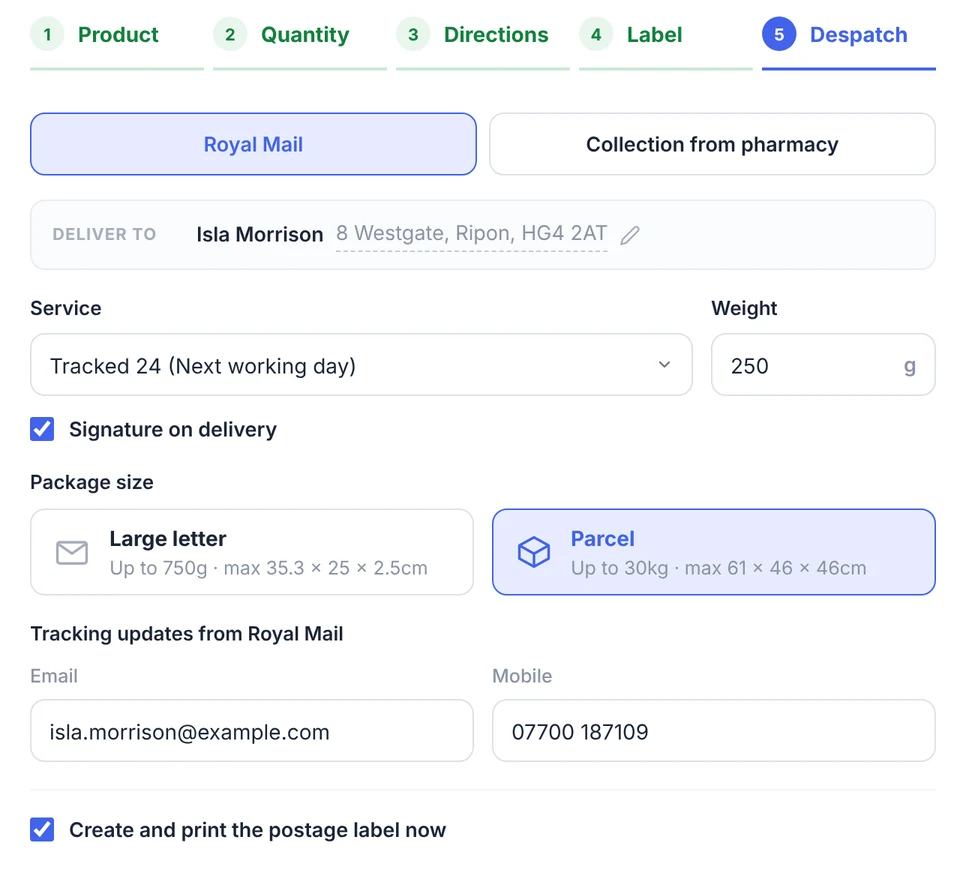
Despatch
No separate courier website to manage. Royal Mail Click & Drop is connected to Dataforge PMR, with tracked and signed-for services available.
A setup planned around your pharmacy and the way prescriptions reach you today.
A walkthrough of private prescription dispensing in Dataforge PMR.
Your pharmacy details and formulary set up.
Your team added and your delivery options connected.
Training completed and your prescriptions dispensed from the queue.
Dataforge PMR is built for private pharmacies and clinics rather than adapted from an NHS system. It covers online consultation forms, prescriber review, private prescribing, dispensing, labels, the prescription-only medicine register, controlled drug registers, bookings and Royal Mail delivery in one system.
NHS PMR systems are designed around the Electronic Prescription Service and NHS claims. A private pharmacy works differently. Its prescriptions arrive from a website, a clinic or an outside prescriber, patients need identity checks before supply, and each sale is recorded in the private prescription register. Dataforge PMR is designed around that way of working.
Dataforge PMR replaces the separate systems most private pharmacies would otherwise use for patient records, online consultations, prescribing, dispensing, registers, bookings and delivery. Alongside it you need a website, which Dataforge PMR connects to natively on Shopify, WordPress and WooCommerce or through custom integration, a payment provider and your accounting software.
GPhC guidance expects an online pharmacy to confirm who each patient is, make sure a prescription-only medicine is only supplied after an appropriate consultation with a prescriber, and spot repeated or inappropriate orders. Dataforge PMR asks for live photo identification and a selfie with every consultation form, checks for duplicate orders and lets the prescriber approve, hold or reject each request before it reaches the dispensing queue.
The best PMR system for a private pharmacy is one designed around private prescriptions. It should accept prescriptions from a website, a clinic or an outside prescriber, print dispensing labels, keep the prescription-only medicine register and arrange delivery, without the pharmacy paying for NHS features it does not use.
Yes. Dataforge PMR can be set up before your first patient, and Sync Dynamics, the company behind it, also supports new pharmacies with GPhC registration, websites and standard operating procedures.
Some PMR systems handle both. Dataforge PMR handles private prescriptions only and does not connect to the NHS Electronic Prescription Service, so an NHS pharmacy runs it alongside its NHS system for its private services.
Dataforge PMR is priced per module, so a pharmacy pays only for the modules it uses. A quote is given during the demo.
Yes. Dataforge PMR runs in a web browser, so there is nothing to install and your team can sign in from any computer with an internet connection.
Yes. A clinic with its own pharmacy can prescribe and dispense in Dataforge PMR, and the clinic's prescriptions reach the pharmacy without being entered a second time.
Yes. Your existing patient records are transferred into Dataforge PMR as part of your setup, so your team starts with the patient history it already holds.
Yes. Dataforge PMR subscriptions run for a minimum of twelve months, are billed monthly and renew for a further year unless cancelled, which keeps your monthly cost fixed for each year.
Yes. Support and training for your team are included with every Dataforge PMR subscription.
Yes. Your data belongs to your pharmacy and can be exported if you decide to leave Dataforge PMR.
A private prescription for a prescription-only medicine is valid for six months from the date it was signed, under the Human Medicines Regulations 2012. A prescription for a Schedule 2, 3 or 4 controlled drug is valid for 28 days.
A pharmacy records every prescription-only medicine it supplies on a private prescription. The entry gives the date of supply, the medicine and quantity, the prescriber's name and address, the patient's name and address and the date on the prescription. It is made on the day of supply or the next day, and the record and the prescription are kept for two years. Dataforge PMR keeps this record in its Registers Module.
The label on a dispensed medicine gives the patient's name, the name and address of the pharmacy and the date of dispensing, together with the name of the medicine, the directions for use and any precautions. Pharmacies also print the warning to keep medicines out of the reach and sight of children.
Yes. A private prescription can be issued electronically if it is signed with an advanced electronic signature and sent to the pharmacy as an electronic communication. The exception is a Schedule 2 or 3 controlled drug, which can only be prescribed electronically through the NHS Electronic Prescription Service. Prescribers using the Prescribing Module in Dataforge PMR can issue private e-prescriptions.
Patient data is processed in line with UK GDPR under a Data Processing Agreement included with every subscription, and each member of your team signs in with their own account.
The Dataforge PMR database and its backups are held in the UK. Identity documents and clinical images uploaded by patients are stored in the European Economic Area, in a country approved for UK data transfers.
Dataforge PMR is built to DCB0129, the clinical risk management standard NHS England requires of health IT manufacturers. Sync Dynamics maintains a clinical safety case report, a hazard log and a clinical risk management plan for the system, with clinical safety reviewed by a doctor.
Dataforge PMR holds the records an inspector usually asks to see, including the prescription-only medicine register, controlled drug registers, dispensing records and the identity checks made before each online supply.
Each licence includes three users, and further users can be added in blocks of three as your team grows.
Dataforge PMR is developed by Sync Dynamics Ltd of Blackburn, Lancashire (company number 15767790), which has demonstrated Dataforge PMR at the Pharmacy Show at the NEC in Birmingham for three years running.
A demonstration arranged around your pharmacy, at a time that suits you.