Schedule 2 controlled drugs
Morphine, oxycodone, methylphenidate and every other Schedule 2 drug.
Dataforge PMR writes every CD register and POM register entry from the dispensing record at the moment of supply, so nothing is copied out by hand.
Controlled drug registers
Morphine 5mg modified-release tablets
Statutory and voluntary records in one place.
Morphine, oxycodone, methylphenidate and every other Schedule 2 drug.
Voluntary registers for the medicines you choose to track.
Flower and oils measured in grams or millilitres.
The prescription-only medicine register required by law.
Less admin at every step of the day.
Controlled drug register
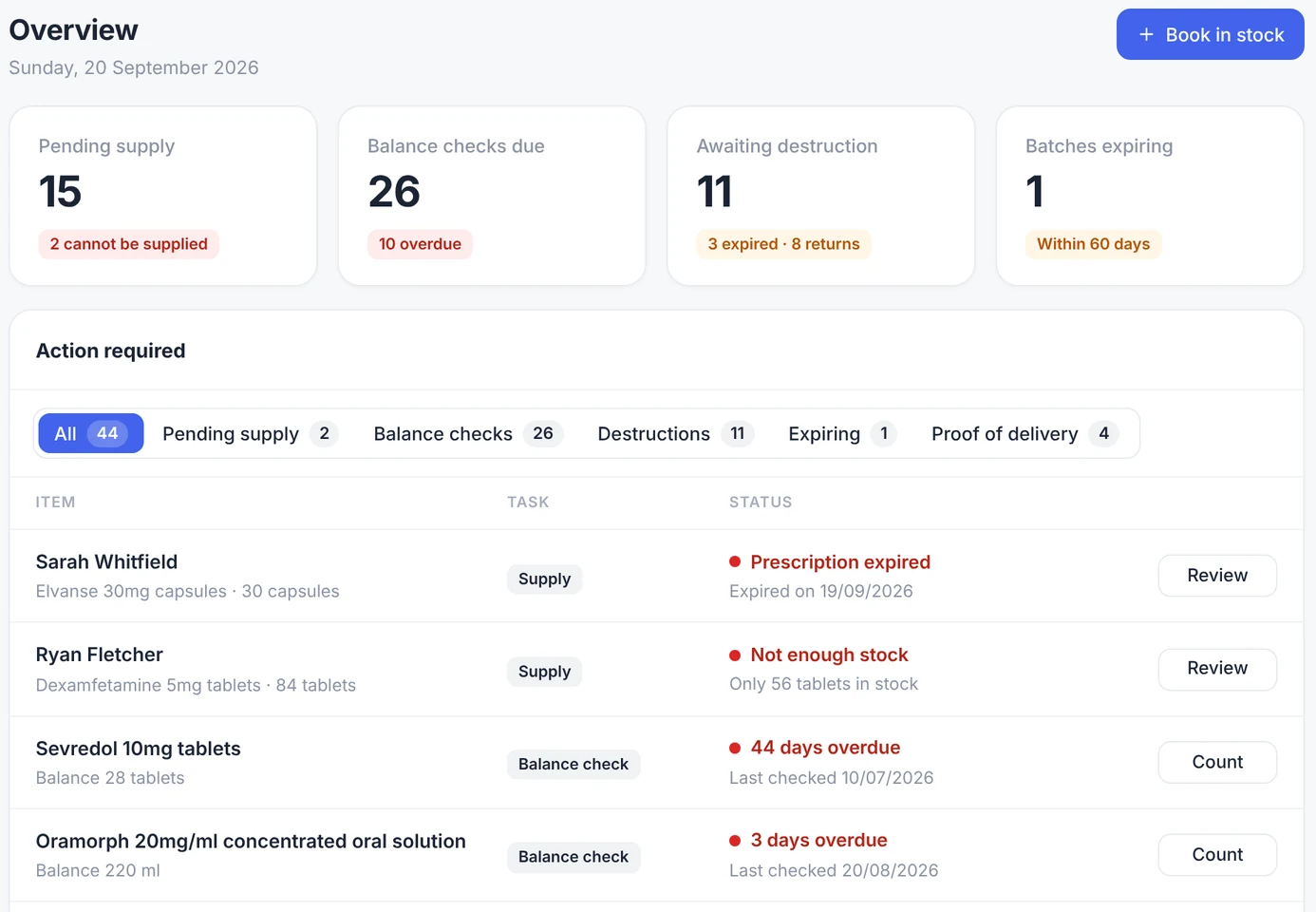
Problems found before an inspector finds them. The overview lists each task that is due, with the reason it needs attention.
Private prescription register
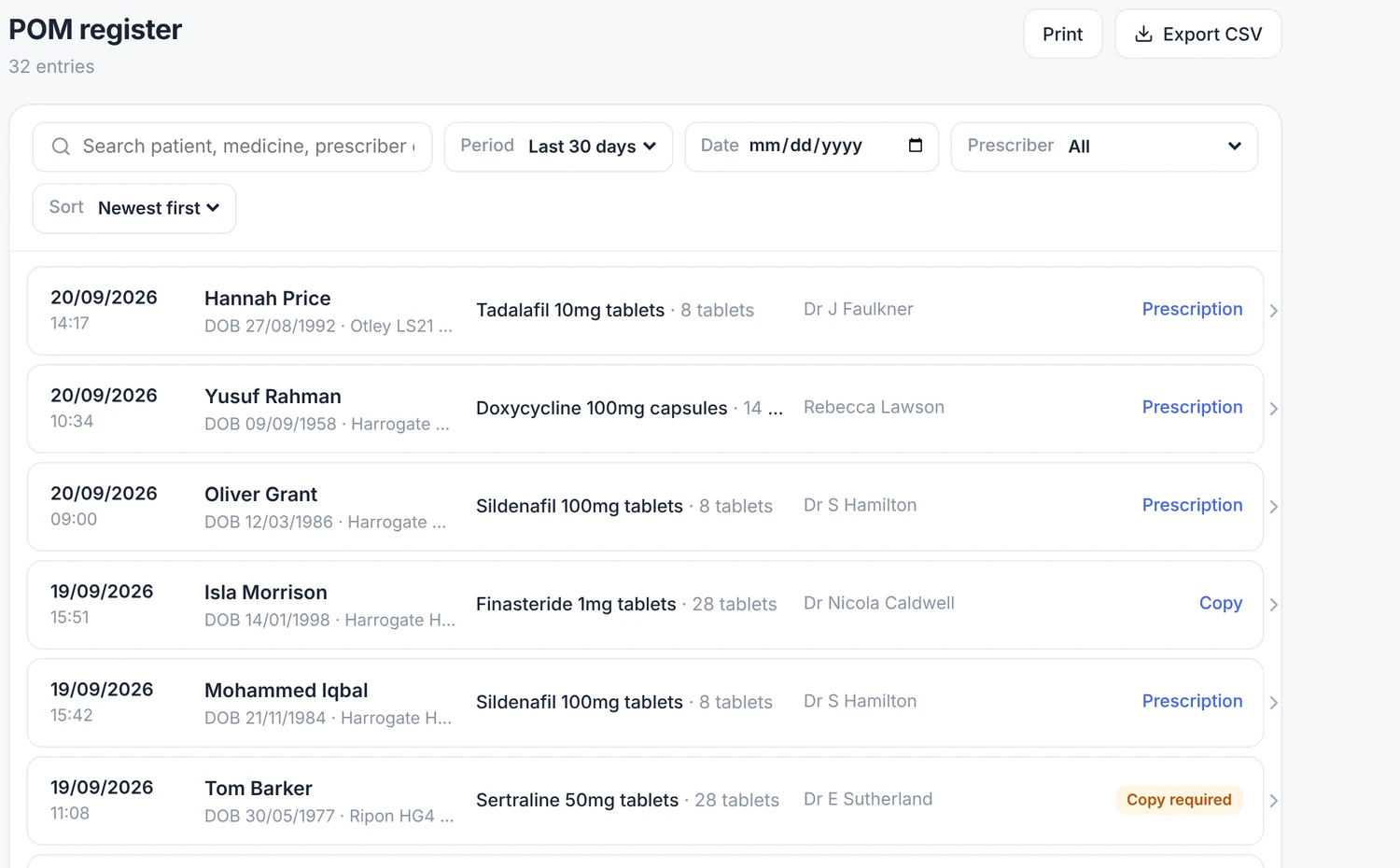
Each entry carries its patient, medicine and prescriber.
Stock and destructions
Exact knowledge of what you hold, from the wholesaler's invoice onwards.
Patient returns
A dedicated register holds them until disposal.
Proof of delivery
Courier, driver and confirmation of delivery saved against the entry.
Reports
Register summaries, destruction logs and stock received.
Related pages: medical cannabis pharmacies, Dispensing Queue and Prescribing Module.
A setup planned around the stock you hold.
A walkthrough with your team.
A register created for each product you stock.
Wholesalers, couriers and drivers added.
Training completed before your first day.
Yes. Regulation 20 of the Misuse of Drugs Regulations 2001 allows a computerised controlled drug register if every entry is attributable to the person who made it, can be audited and is accessible from the pharmacy premises. Regulation 253 of the Human Medicines Regulations 2012 allows the POM register to be written or computerised.
No. The electronic register replaces it. Opening balances are carried across when you switch, and the paper register is closed the same day, because only one register can be in use for each drug at a time.
On the day of the receipt or supply, or on the next day if that is not reasonably practicable. The same rule applies to the controlled drug register and the POM register.
An entry must never be cancelled, obliterated or altered. A correction is made by a dated marginal note or footnote, which Dataforge PMR adds alongside the original entry within an amendment window of 24, 48 or 72 hours set by the pharmacy.
Only Schedule 1 and 2 drugs, such as fentanyl, methadone and lisdexamfetamine. Schedule 3 drugs, including pregabalin, gabapentin, midazolam and temazepam, do not need one.
Yes. A separate page is needed for each strength and form of a drug, headed with its class, strength and form.
The date it was received, the name and address of the supplier and the quantity received.
The date of supply, the name and address of the person supplied, the name and address of the prescriber, the quantity, whether it was collected by the patient, their representative or a healthcare professional, and whether proof of identity was requested and provided.
When a healthcare professional collects a Schedule 2 drug, their name and address are recorded and identification is requested unless the pharmacist already knows them. For a patient or their representative, asking for identification is at the pharmacist's discretion.
No. It is expected as good practice rather than required by law, and Dataforge PMR keeps one for every register.
The law sets no frequency. Each pharmacy sets its own in its standard operating procedures, and Dataforge PMR reminds the team when a check is due.
Investigate it promptly and record the outcome in the register. The GPhC expects any discrepancy that cannot be resolved to be reported to the NHS controlled drugs accountable officer.
A person authorised by the Secretary of State or appointed by the NHS controlled drugs accountable officer, who cannot act as the witness personally. The date and quantity destroyed are entered in the register and signed by the witness.
No. Drugs returned for destruction are exempt from the register, and their destruction needs no authorised witness.
Yes, for Schedule 2 and 3 drugs. In England they are submitted to the NHS Business Services Authority.
The date of supply, the medicine with its quantity, form and strength, the name and address of the prescriber, the name and address of the patient and the date on the prescription.
NHS prescriptions, prescriptions for oral contraceptives, supplies already entered in the controlled drug register and wholesale sales where the order or invoice is kept.
At a patient's request, the date, the medicine with its quantity, form and strength, the patient's name and address and the nature of the emergency. At a prescriber's request, the date the prescription is received is added when it arrives.
Each later supply can be entered with its date and a reference to the entry for the first supply.
For two years from the date of the last entry, under regulation 23 of the Misuse of Drugs Regulations 2001.
For two years from the date of the last entry, under regulation 253 of the Human Medicines Regulations 2012.
For two years from the date of supply, or from the final supply on a repeatable prescription. Schedule 4 and 5 controlled drug prescriptions are kept for two years from the last delivery made under them.
For at least two years, which is the period set by the Misuse of Drugs Regulations 2001.
For at least six years, following NICE guidance on controlled drugs.
For at least seven years, following NICE guidance on controlled drugs.
Recipient signatures and transport documents for at least two years, and driver identification for at least three months.
For at least five years, covering orders, certificates of analysis or conformity, invoices and the details of each supply so a product can be traced.
For at least eight years for adults. For children, until their 25th birthday, or their 26th if they were 17 when treatment ended, and for at least ten years after a patient's death.
For at least five years, under the Medicines (Pharmacies) (Responsible Pharmacist) Regulations 2008.
For at least ten years from the date of the incident, rising to twenty years for serious incidents or any incident that needed a formal investigation.
No. A digital record has the same minimum retention period as paper, and it must stay recoverable and show who has accessed it throughout that period.
They are reviewed before anything is destroyed, and the reason for each decision is documented. Nothing is destroyed while a subject access request, legal proceedings or an inquest is pending.
Book a time that suits you and our team will answer your questions.